
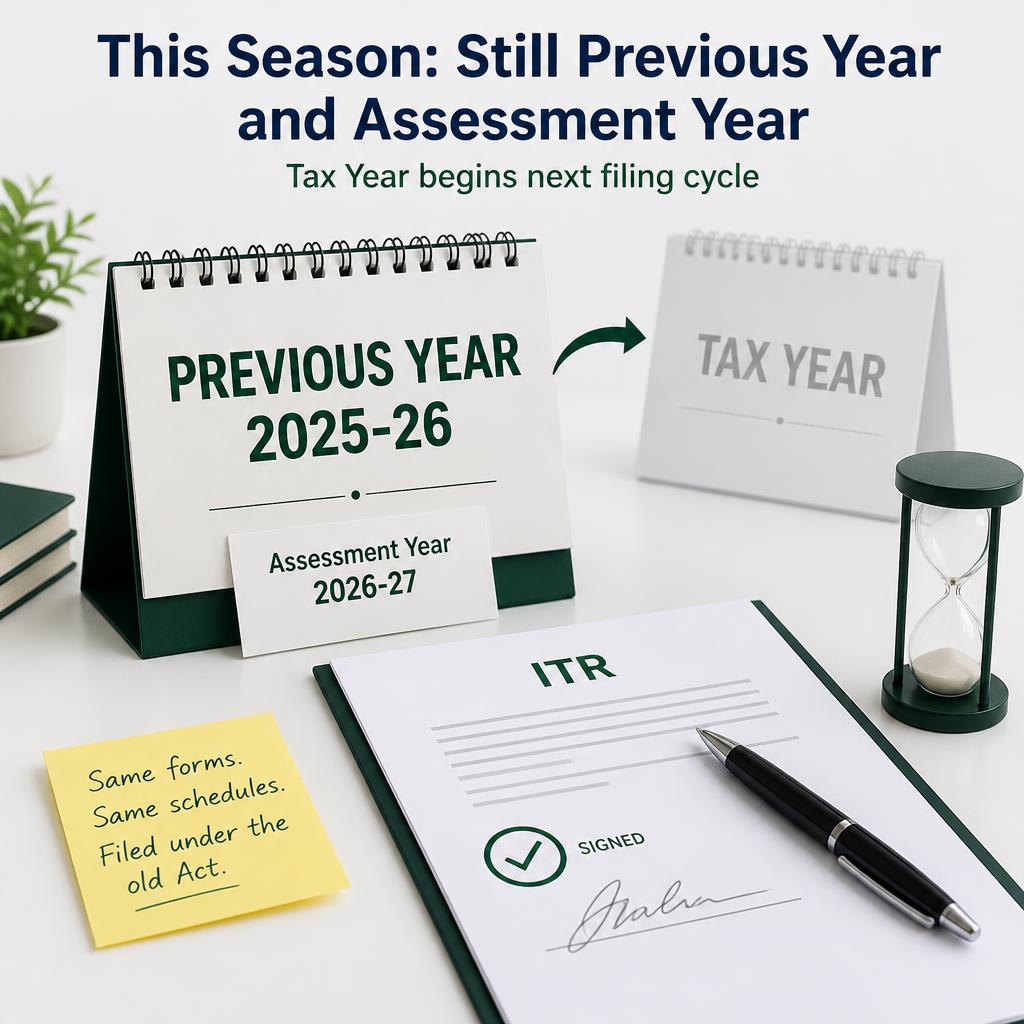
The Income Tax Act 2025 came into effect on 1 April 2026. For most organisations and individuals, this marks a shift in the regulatory terrain, but not for the return you are filing this season. If you are filing by 31 July for ITR-1 and ITR-2, or by 31 August for ITR-3 and ITR-4, you are filing under the Income Tax Act, 1961, using Financial Year 2025-26 records and Assessment Year 2026-27. The Income Tax Act 2025 applies to income earned from 1 April 2026 onward, which will be filed as a return next year. Knowing which Act governs this season’s filing will prevent confusion when you prepare your return.
Table of Contents
ToggleWhat changed in the Income Tax Act 2025
The central change is the introduction of a single Tax Year, replacing the previous system of Assessment Year and Previous Year. Under the earlier act, a return filed in 2026 covered the financial year ending 31 March 2026 (the Previous Year), and the assessment carried into the Assessment Year (2026-27). The Income Tax Act 2025 consolidates this into a single Tax Year. The return you file this season covers Previous Year 2025-26, assessed as Assessment Year 2026-27 under the Income Tax Act, 1961. The Tax Year concept only applies from income earned starting 1 April 2026, which becomes Tax Year 2026-27 under the new Act.
This consolidation matters for next year’s filing, not this one. The records you need to support this season’s return are those from 1 April 2025 to 31 March 2026, and the form still references Previous Year and Assessment Year, the same structure you have used before.
The filing deadlines by entity type
The deadline for individuals filing ITR-1 (Individuals with income from salary, pension, one house property, and other sources) and ITR-2 (Individuals other than those filing ITR-1) is 31 July 2026. These are the standard individual income tax return forms under the Income Tax Act, 1961.
For individuals and businesses filing ITR-3 (Individual engaged in business or profession) and ITR-4 (Individuals having income from business or profession, with or without other income), the deadline is 31 August 2026. This additional month allows for the more detailed records required in these returns.
For corporate entities filing under the Corporation provisions of the act, the filing deadline is 31 October 2026. The structure and data mapping for corporate returns remains under the Income Tax Act, 1961, for this filing season. The single Tax Year structure under the Income Tax Act 2025 applies from income earned starting 1 April 2026
Income Tax Act 2025: records and form references to confirm before filing
Before you file, verify three things. First, locate all records covering 1 April 2025 to 31 March 2026. This is the data set your return will reference. Under the earlier act, a return filed in 2026 covered 1 April 2025 to 31 March 2026 (the Previous Year). Confirm you are pulling from the correct financial year.
Second, identify which form you should be filing. The form categories for ITR-1 through ITR-4 remain unchanged from previous years under the Income Tax Act, 1961. The determination depends on your income profile and business structure for this filing year.
Third, cross-check the data structure within the form against how your records are organised. The schedules within ITR-1 and ITR-2 for this season follow the same structure as previous years, since these forms remain under the Income Tax Act, 1961. If your organisation has been running accounts on the Assessment Year basis (tracking income separately from April in one year and ending in March of the next), continue using that structure for this filing. The remapping to a single Tax Year applies once forms under the Income Tax Act 2025 are released for next year’s filing.
Where organisations typically encounter friction
This season’s ITR-1, ITR-2, ITR-3, and ITR-4 forms remain unchanged under the Income Tax Act, 1961. The friction points below become relevant once forms under the Income Tax Act 2025 are released for next year’s filing.
The first friction point will be in how deductions and exemptions align with the new form structure once it arrives. Organisations that have filed the same way for multiple years should expect schedule references to shift when the Income Tax Act 2025 forms replace the current ones.
The second friction point will be in the treatment of income that straddles the calendar transition. Once the single Tax Year structure takes effect, from income earned starting 1 April 2026, organisations will need to classify income and expenses under that single Tax Year framework.
The third friction point will be in TDS and advance tax payments. Once the Income Tax Act 2025 forms are released, payments made or TDS deducted from 1 April 2026 onward will need to be mapped against the new credit sections, an exercise separate from finalising this season’s TDS records for Financial Year 2025-26.
Who should begin preparation now
If you are a CFO or a company secretary managing multiple returns, or a founder filing a business return this season, begin preparation now. The deadlines are tight: 31 July for most individual returns, 31 August for self-employed individuals, 31 October for corporate entities requiring audit. This season’s forms follow the same structure as previous years under the Income Tax Act, 1961, so the preparation work is familiar, locating records, confirming the correct form, and verifying deduction schedules against what you filed last year.
Confirm with your tax counsel or compliance advisor which forms apply to your situation, locate all records covering Previous Year 2025-26 (1 April 2025 to 31 March 2026), and cross-check your records organisation against the schedules within the form you will be filing. Data mapping errors, not the filing mechanics themselves, cause most of the friction organisations encounter this season.