
Mid-size Indian companies sit in an uncomfortable spot in the compliance landscape. Large enough to have multi-state operations, multi-regulatory obligations, and teams spread across functions. Small enough that the compliance workload falls on two or three people who are also handling a dozen other things.
The tool decision matters because the wrong one does not just fail to help. It creates a false sense of coverage. The company files what the tool reminds it to file, misses what the tool does not cover, and discovers the gap when the Registrar of Companies or a labour authority issues a notice. This is exactly where choosing the right compliance management tool for mid-size Indian companies becomes critical.
According to data provided to the Lok Sabha in February 2026 by the Ministry of Corporate Affairs, 1,066 companies were penalised under the Companies Act in the full 2024-25 fiscal year, with total fines amounting to Rs 109 crore. Most of those penalties were not the result of deliberate non-compliance. They came from missed deadlines, incomplete filings, and inadequate tracking systems.
The six criteria below are what a mid-size Indian company should evaluate when selecting a compliance management tool. Each one addresses a structural gap that appears repeatedly in how compliance is handled at this company size.
Table of Contents
Toggle1. Why a Compliance Management Tool for Mid-Size Indian Companies Needs Deadline Automation
The volume of compliance deadlines a mid-size Indian company carries across MCA, GST, EPFO, ESIC, labour law, and state-specific statutes makes manual tracking unreliable. This is the first thing any compliance management tool for mid-size Indian companies needs to get right. One senior compliance officer cannot hold all of it in a spreadsheet and stay current with regulatory amendments simultaneously.
MCA charges late fees on a per-day basis under the Companies Act, 2013, and those fees can escalate from a small amount to thousands or even lakhs of rupees. Once imposed, they are difficult to reverse. A tool that does not automate deadline alerts is not a compliance tool. It is a calendar with extra steps.
What to look for: automated reminders set against actual statutory due dates, not generic calendar entries. The tool should update those dates when the MCA or the relevant authority issues an extension or amendment, rather than requiring someone to update the tool manually.
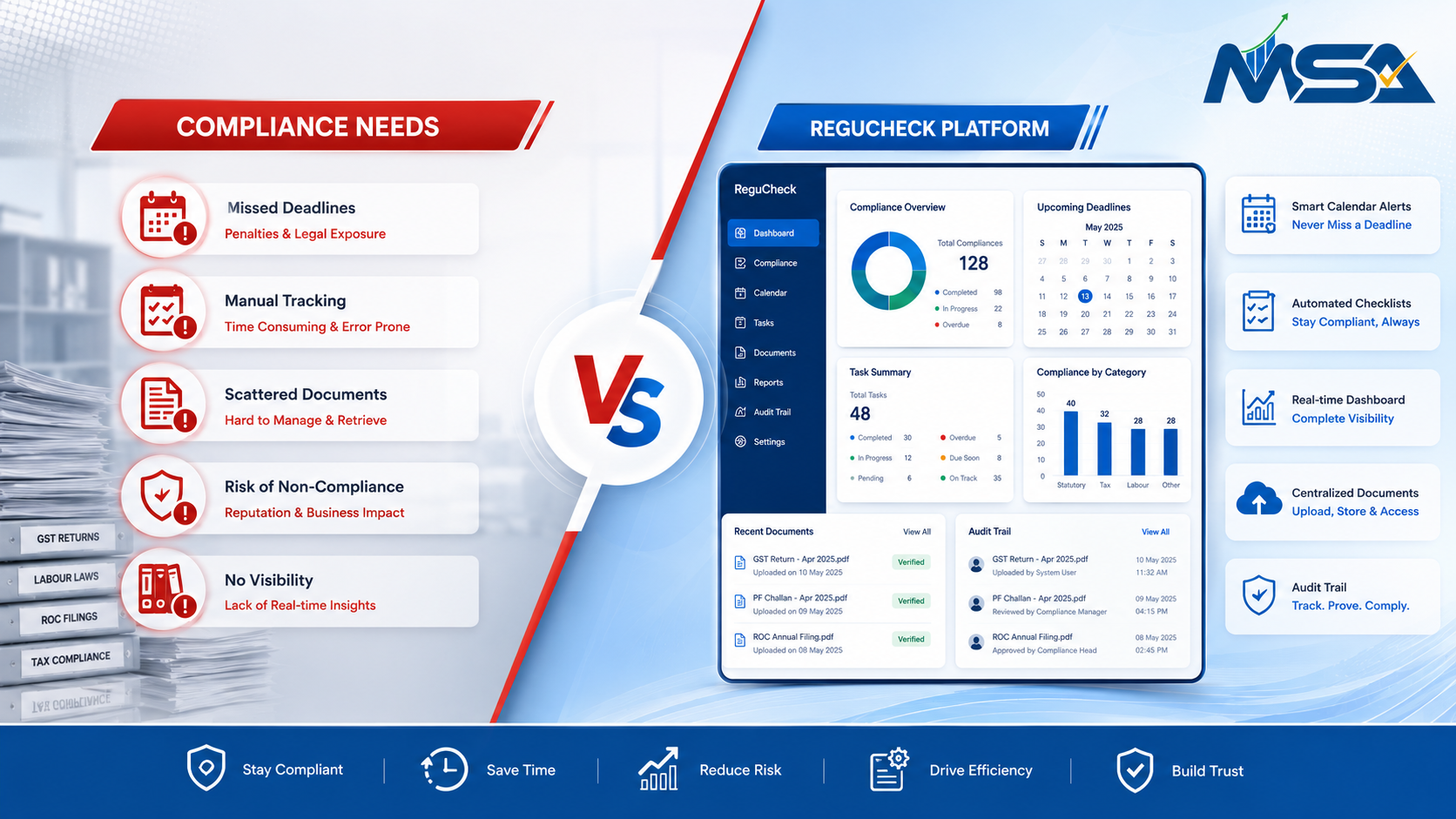
ReguCheck maps each obligation to its current statutory deadline and pushes alerts to the responsible team member in advance. When a due date changes, the tool updates. The team does not have to monitor circulars to keep the calendar accurate.
2. Audit trail
Every compliance action, filing, document upload, and sign-off needs to be traceable. Who handled it. When. What was submitted. This is not administrative tidiness. It is the record that protects the company and its directors when a regulator requests evidence of compliance.
Under the Companies Act, 2013, directors can face personal consequences for non-compliance, including monetary penalties and, in certain cases, disqualification from holding directorships. The exposure is personal, not just corporate. A clean audit trail is one of the few things that can demonstrate, clearly and quickly, that the obligation was met. Without this, even a well-marketed compliance management tool for mid-size Indian companies offers little real protection.
What to look for: timestamped logs for every action taken within the tool. Document version history. Confirmation of filings with attached acknowledgment records. The trail should be exportable for use during audits or regulatory inquiries.
ReguCheck maintains a full timestamped activity log for each compliance item. Every upload, sign-off, and status change is recorded against the user who executed it. The records can be extracted and presented in a format that holds up during scrutiny.
3. Multi-location tracking
A mid-size company operating across two or more states carries a different compliance load than one operating from a single registered address. Labour law obligations vary by state. Professional tax structures differ. Factory Act applicability depends on the headcount at each location. CLRA compliance depends on what contractors are deployed at each site. This is where a compliance management tool for mid-size Indian companies earns its keep — or fails to.
The risk in multi-location operations is that head office compliance gets handled while branch compliance gets deferred. The branch is smaller. The notices come to the branch. By the time they reach the compliance function, the grace period has passed.
What to look for: the ability to configure compliance tracking by legal entity, state, and physical location separately. Alerts should route to the person responsible for that location, not to a central queue that the central team may not monitor in time.
ReguCheck is built to handle multi-entity and multi-location configurations. Each location carries its own compliance calendar. Each calendar route is assigned to the responsible person. The central compliance view shows the status across all locations without collapsing the detail.
4. Regulatory update monitoring
India’s regulatory environment requires tracking updates from bodies including SEBI, RBI, the GST Council, and the MCA. The challenge for mid-size companies is not the big amendments that get covered in the financial press. It is the notifications, circulars, and department-level clarifications that change how an existing obligation is interpreted or executed. Those changes often reach compliance teams weeks after they come into effect, if at all. A compliance management tool for mid-size Indian companies is only as good as how quickly it reflects these changes.
A tool that carries a static compliance checklist is particularly risky here. The checklist reflects the law as it stood when the tool was built. The law, in several areas of Indian regulation, does not stay still for long.
What to look for: a team behind the tool that monitors regulatory updates and reflects them in the platform. The due dates and compliance requirements inside the tool should match the current state of the law, not the state of the law at the time of the tool’s last update.
ReguCheck maintains a regulatory monitoring function that tracks changes from central and state-level authorities and updates the platform accordingly. The client does not have to monitor the Official Gazette to keep the tool current.
5. Collaboration features
Compliance execution at a mid-size company rarely sits in one department. The finance team handles GST and TDS. HR handles PF, ESIC, and labour law. The company secretary handles MCA filings. Each function operates on its own timeline, and the compliance officer is typically dependent on each of them to deliver inputs before a deadline can be met.
When collaboration is managed over email threads and WhatsApp messages, two things tend to happen. Inputs arrive late. The compliance officer has no documented record of having requested them, which matters when a deadline is missed and the question of accountability comes up.
What to look for: task assignment within the tool. The ability to assign a compliance item to a specific person, set a reminder ahead of the due date, and track whether the assigned person has completed the action. Status visibility for the compliance head without needing to follow up manually.
ReguCheck allows compliance tasks to be assigned within the platform. Each assignee receives reminders. The compliance head sees the status of every pending action from a single view. The follow-up trail is inside the tool, not scattered across message threads.
6. Customizability
No two mid-size Indian companies carry the same compliance profile. A manufacturing company in Maharashtra with contract labour and a factory licence carries a different set of obligations from an IT services firm operating out of Bengaluru. A company in the healthcare sector carries PCPNDT obligations that do not apply to any other sector. A company holding an NBFC registration carries a set of RBI reporting requirements that will not be found in a generic compliance checklist.
A tool that offers only a fixed compliance list will cover the common obligations and miss the sector-specific or licence-specific ones that carry the most exposure for the particular company.
What to look for: the ability to add obligations that sit outside the standard checklist. Custom fields for licence renewals, sector-specific filings, and obligations specific to the company’s operating structure. The tool should accommodate the company’s actual profile, not a generic version of it.
ReguCheck allows custom obligation entries alongside the standard statutory list. If the company carries a licence renewal, a sector-specific filing, or an internal governance deadline that sits outside the standard framework, it can be added to the same calendar and tracked with the same alert and audit trail infrastructure. This is what separates a genuine compliance management tool for mid-size Indian companies from a generic checklist app.
The Red Zone: What a Compliance Management Tool for Mid-Size Indian Companies Must Cover
The six criteria above address the categories of failure that a compliance management tool for mid-size Indian companies most commonly produces if it is poorly built. Automation closes the missed-deadline risk. Audit trail addresses the personal liability exposure. Multi-location tracking prevents the branch-level gap. Regulatory update monitoring keeps the checklist accurate. Collaboration features bring input delivery inside the tool where it can be tracked. Customizability makes sure the tool covers the company’s actual obligations, not a standardised approximation of them.
The right way to evaluate any compliance tool, including ReguCheck, is to run each criterion against the tool’s actual capability, not against its marketing material. Ask for a demonstration of the audit trail. Ask how regulatory updates are pushed to the platform and how quickly. Ask how multi-entity configurations are set up. A tool that holds up across all six is materially different from one that covers three of them and leaves the rest to spreadsheets and email.
If you are evaluating a compliance management tool for mid-size Indian companies and want to see how ReguCheck handles your specific compliance profile, request a configuration review. Bring your list of current obligations. The review will map them against the tool and identify where coverage is complete and where it is not.